
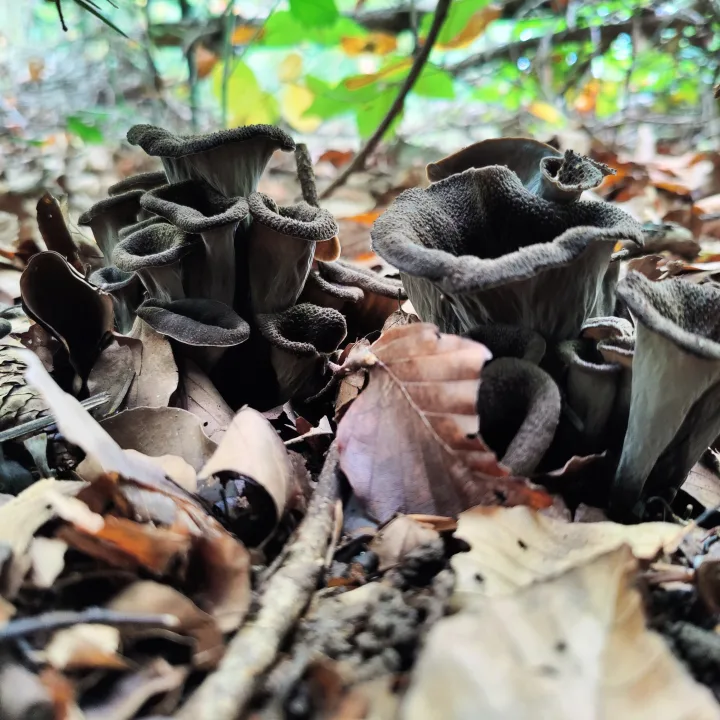
Craterellus cornucopioides
Black trumpet mushrooms are mainly associated with cool broadleaf woodland, often near beech or oak. In Switzerland, their indicative season runs from late summer into autumn, with strong local variation.
Broadleaf woodland, often with beech or oak, on cool soils rich in humus.
Late summer into autumn, with strong local variation.
Read cool beech woodland for black trumpets
Black trumpets are mainly associated with broadleaf woodland, often with beech or oak. Dark litter, intact humus and shallow hollows can retain useful coolness after rain.
Their colour hides them among leaves. Walk slowly without raking or turning litter. After finding one group, observe the same contour and continuity of microhabitat rather than trampling widely.
Check shape and outer surface
A small dark funnel fungus is not automatically a black trumpet. The cavity, thin flesh, outer surface, transition to the stem and condition all require inspection.
Very old or soaked specimens lose features and deteriorate quickly. Discard degraded mushrooms and have every specimen intended for consumption checked separately.
Identification and lookalikes
Other dark or funnel shaped fungi may appear similar. Shape, underside, texture, stem, habitat and condition of every specimen must be checked.
The map helps you search. Never identify.
Cepello does not identify mushrooms and never confirms that a specimen is edible. Have your entire collection checked by an official inspection service.
Uncertainty or mild symptoms: Tox Info Suisse 145. Acute symptoms: 144.Read the safety guide →FAQ
Frequently asked questions
When is black trumpet mushroom season?
Mainly late summer into autumn in cool broadleaf woodland, depending on rain, temperature and elevation.
Does the map guarantee black trumpets?
No. It indicates potentially suitable areas but does not detect present fruiting bodies or guarantee a harvest.
Rain, soil, trees and season
Explore Switzerland
SwissFungi, WSL · VAPKO · Tox Info Suisse
Checked on 25.08.2026. An online profile can never confirm identity or edibility. Keep species separate and have everything intended for consumption inspected.