
black trumpets are never guaranteed in Solothurn. Start with the ecological profile of Craterellus cornucopioides. Plateau and Jura ridges defines the local frame; assess its effect on moisture, temperature and aspect. A potential mushroom spot for black trumpets in Solothurn needs several matching clues rather than a familiar woodland name alone.
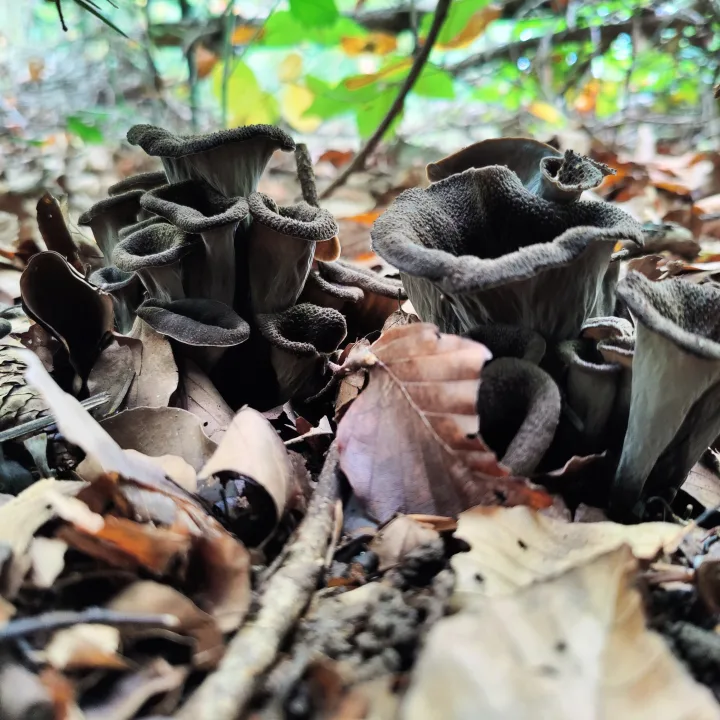
Habitat match
Broadleaf woodland, often with beech or oak, on cool soils rich in humus. In Solothurn, the regional context is Plateau and Jura ridges. Read mature broadleaf trees, dark humus, damp litter and shallow depressions without disturbing the ground.
Read the local terrain
Plateau forests quickly meet limestone slopes and Jura beech woods. This mosaic calls for comparing terrain bands rather than treating the whole canton as uniform.
Choose the timing
Late summer into autumn, with strong local variation. In Solothurn, elevation, aspect and moisture retention can advance or delay that indicative window.
Search plan
Choose two broad areas within this terrain: Plateau and Jura ridges. Compare the same soil and vegetation clues, and move on when the terrain does not fit. Cepello gives no exact spot and identifies no specimen. Treat every possible black trumpet spot as a field hypothesis, never as a guaranteed location.
Assess a potential black trumpet mushroom spot
In Solothurn, a potential mushroom spot combines several matching signals: habitat compatible with Craterellus cornucopioides, suitable terrain, retained moisture and recent weather. Spot does not mean a secret coordinate or a guaranteed find.
The map helps you search. Never identify.
Cepello helps choose an area. The app does not identify mushrooms and never confirms edibility.
Cantonal foraging rules →FAQ
Frequently asked questions
Which habitat should you compare for black trumpets in Solothurn?
Broadleaf woodland, often with beech or oak, on cool soils rich in humus. The local context is: Plateau forests quickly meet limestone slopes and Jura beech woods. Never use it as evidence of presence.
Does the map guarantee finding black trumpets?
No. It helps compare potential conditions, reveals no exact location, identifies no mushroom and never confirms edibility.