
For chanterelles in Ticino, favour cool, well-drained forest soil beneath chestnut, beech or conifers. After heavy rain, gentle slopes with damp, aerated moss and litter are stronger than saturated benches. A potential mushroom spot for chanterelles in Ticino needs several matching clues rather than a familiar woodland name alone.
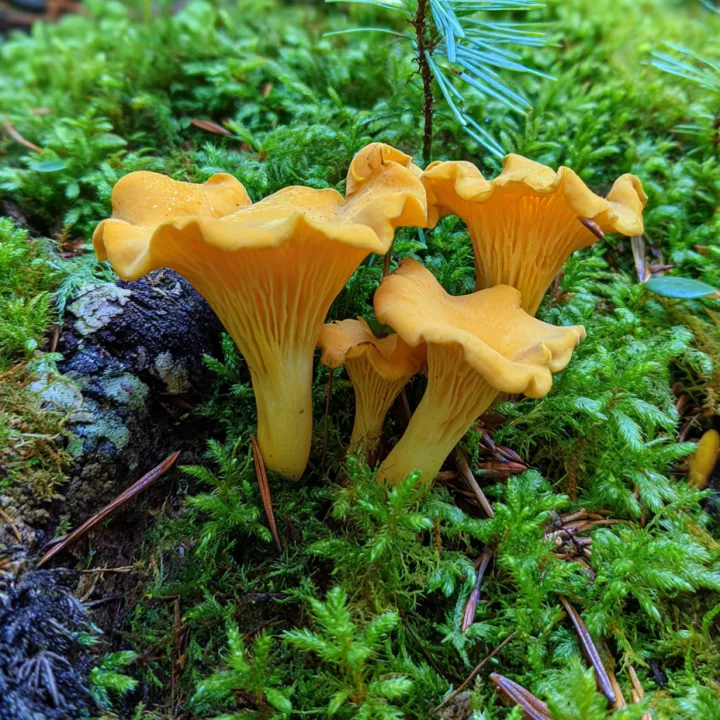
Habitat match
Chanterelles require steady moisture without suffocation. Thin litter, some light at ground level and mature tree roots fit better than a flooded understory.
Read the local terrain
Ticino slopes shift quickly between exposed rock, benches and gullies. A bench collects water while a nearby convexity dries, making microtopography essential.
Choose the timing
Warm rain can wet the surface quickly, but allow the soil to regain air. Late in a dry spell, wooded shaded slopes often retain the most coherent clues.
Search plan
Follow a gentle slope across three small landforms and compare moss, litter depth and drainage beneath the same trees. Exclude saturated pockets and dry rock slabs. Treat every possible chanterelle spot as a field hypothesis, never as a guaranteed location.
Assess a potential golden chanterelle spot
In Ticino, a potential mushroom spot combines several matching signals: habitat compatible with Cantharellus cibarius, suitable terrain, retained moisture and recent weather. Spot does not mean a secret coordinate or a guaranteed find.
The map helps you search. Never identify.
Cepello helps choose an area. The app does not identify mushrooms and never confirms edibility.
Cantonal foraging rules →FAQ
Frequently asked questions
Do chanterelles grow only at elevation in Ticino?
No. Several forest belts may fit. Soil, trees, moisture and temperature are more useful than elevation alone.
Is a very mossy chestnut wood enough?
No. Moss indicates moisture, but drainage, litter and tree condition must also be assessed.