
For chanterelles in Vaud, focus on fairly open beech, fir or spruce woods with damp but not waterlogged soil. Moss, small benches and breaks in slope help reveal moisture patterns, but none guarantees a fruiting. A potential mushroom spot for chanterelles in Vaud needs several matching clues rather than a familiar woodland name alone.
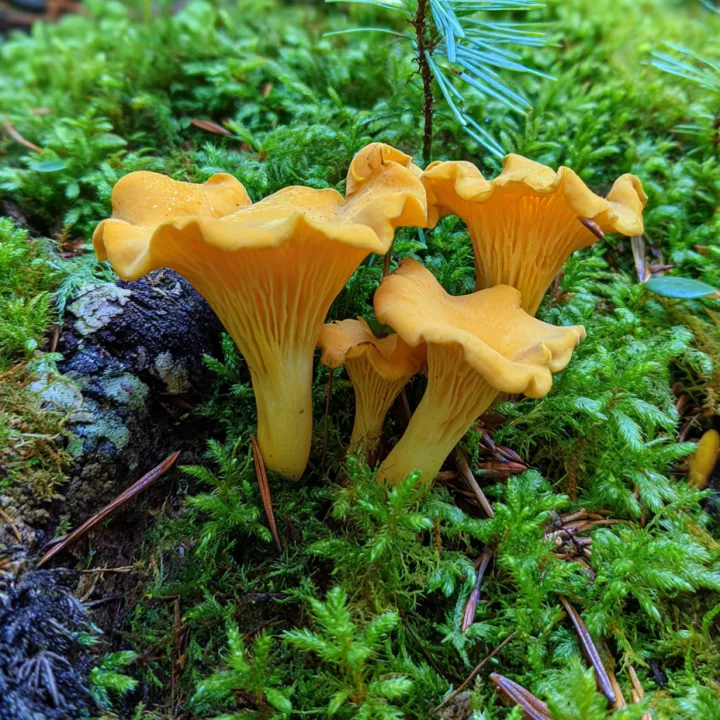
Habitat match
Chanterelles suit active, aerated soils with fairly thin litter. Mixed stands where light still reaches the ground are often easier to read than dark plantations with a deep needle layer.
Read the local terrain
The rolling Jorat can shift from damp to dry over a short distance. In the Jura and Pre-Alps, read sheltered hollows and slopes that drain without drying out completely.
Choose the timing
One shower on dry ground is rarely enough. Look instead for a run of damp days that has cooled the surface layer, then compare shade, elevation and aspect.
Search plan
Walk a short transect across upper slope, bench and lower slope. Note where moss and litter remain springy, then inspect around the same tree mix without trampling fragile ground. Treat every possible chanterelle spot as a field hypothesis, never as a guaranteed location.
Assess a potential golden chanterelle spot
In Vaud, a potential mushroom spot combines several matching signals: habitat compatible with Cantharellus cibarius, suitable terrain, retained moisture and recent weather. Spot does not mean a secret coordinate or a guaranteed find.
The map helps you search. Never identify.
Cepello helps choose an area. The app does not identify mushrooms and never confirms edibility.
Cantonal foraging rules →FAQ
Frequently asked questions
Does moss always indicate chanterelles?
No. Moss mainly indicates moisture. Associated trees, soil aeration and the length of the damp period must also fit.
Is the Jorat better than the Vaud Jura?
Not necessarily. The Jorat may hold moisture longer, while sheltered Jura hollows can stay cooler. Compare the recent conditions.