
In St. Gallen, frequent moisture helps only when soil remains aerated. Compare mature beech, fir and spruce woods from the Plateau to Toggenburg, avoiding saturated bottoms and exposed ridges. A potential mushroom spot for porcini in St. Gallen needs several matching clues rather than a familiar woodland name alone.
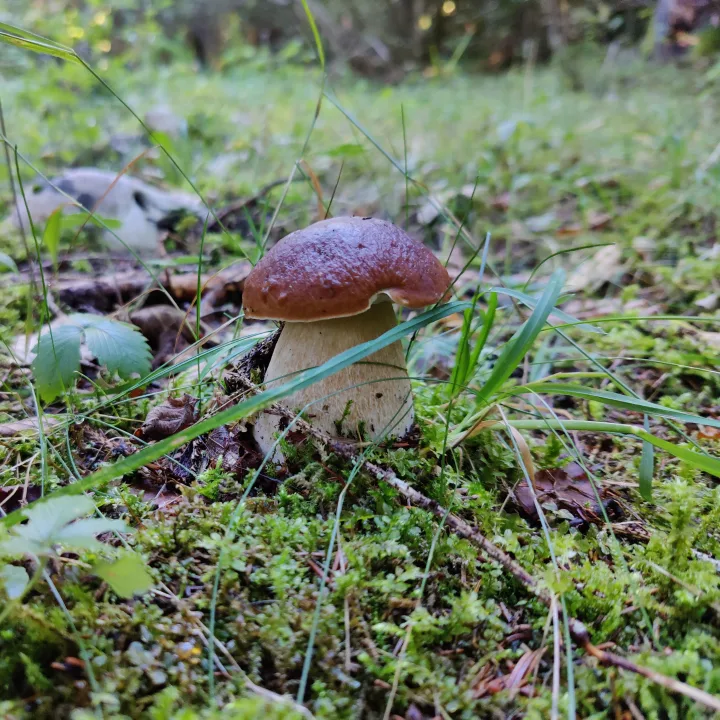
Habitat match
Mature mixed stands offer partner roots and a stable microclimate. Abundant moss signals moisture, but saturated spongy soil is not an equivalent clue.
Read the local terrain
The Rhine Valley, Toggenburg hills and Alpine foothills differ sharply in wind and rainfall. Well-drained side slopes are usually easier to read than valley bottoms.
Choose the timing
After a long wet spell, allow saturated soils to regain air. In drier weather, shaded slopes beneath a closed canopy may keep a longer window.
Search plan
Cross a slope from top to bottom and classify three states: dry, cool and aerated, saturated. Focus on the middle band where partner trees are established. Treat every possible porcini spot as a field hypothesis, never as a guaranteed location.
Assess a potential porcini mushroom spot
In St. Gallen, a potential mushroom spot combines several matching signals: habitat compatible with Boletus edulis, suitable terrain, retained moisture and recent weather. Spot does not mean a secret coordinate or a guaranteed find.
The map helps you search. Never identify.
Cepello helps choose an area. The app does not identify mushrooms and never confirms edibility.
Cantonal foraging rules →FAQ
Frequently asked questions
Does more rain mean more porcini in St. Gallen?
No. Excess water reduces soil aeration. Duration, drainage and temperature matter alongside quantity.
Is Toggenburg the only area to consider?
No. The eastern Plateau and Alpine slopes may also fit depending on elevation, canopy and recent weather.